From Anxiety to Action: How I Created 100+ Visual Nudges in 60 Days
In a world drowning in information, action - not more reading - is the antidote to anxiety. Here is how a 60-day daily drawing commitment turned overwhelm into 100 visual nudges that help people think clearly and act better.

Tanmay Vora
On that evening in November 2025, I felt overwhelmed. My feeds were full of AI-generated content about how AI will make humans irrelevant. And yet, paradoxically, the more information available, the more anxious people felt. Myself included.
In my leadership programs I often coach leaders to act in the face of anxiety. That creative doing paired with consumption expands your horizon. That consumption alone can amplify noise and make us anxious.
The Commitment to Create Daily
I did the same. I decided to commit to a simple practice of drawing daily. But before I started, I asked myself two simple questions:
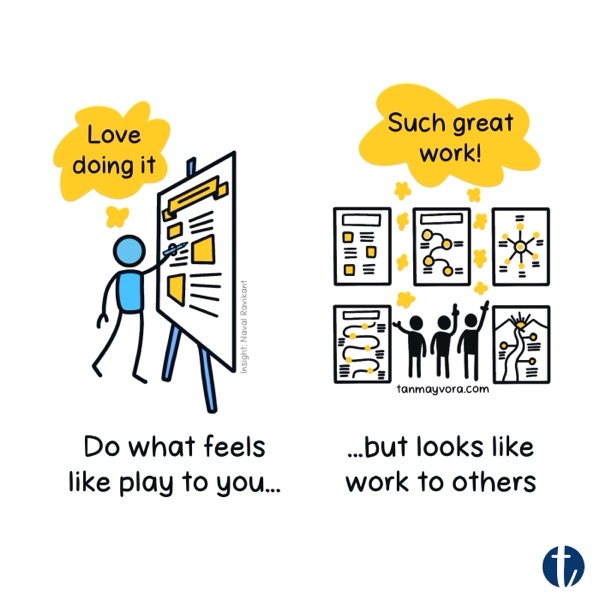
What would be fun for me to do and genuinely useful for others?
What looks like play to me but looks like work to the others? (HT: Naval Ravikant)
The answer came from the same dilemma that I was facing: people are reading more than ever, yet retaining less. Information is at our fingertips, yet wisdom isn’t sticking. The signals are all buried under noise.
So next, I asked a third design question:
What if an idea is depicted in form of a minimal visual story that is understood by our brain in less than 30 seconds? Sketched by hand, visually distinct, small enough to create, and useful enough to reuse.
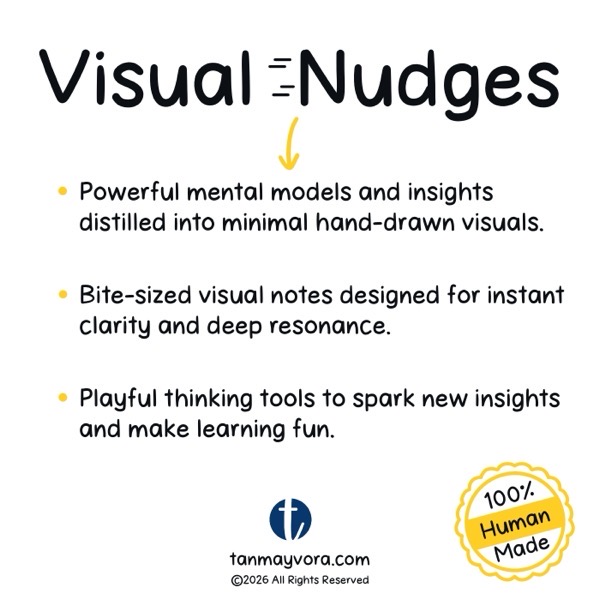
The answer to all these these questions was: Visual Nudges
A visual nudge is a simple visual story that gently nudges us to think deeper. Something that is drawn by hand, created for instant processing, reusable in meetings, memorable in workshops. Challenging enough to disturb a comfortable assumption.
I committed to 60 days of creating one visual nudge everyday.
The process was deliberately humble.
I started with listing down ideas that I had in my notes from reading books and articles. I then created a few rough sketches on a piece of paper to find best and simplest way to tell a story.
Once I had a few rough sketches, I moved to creation. To ensure minimal choices, I firmed up a minimal template, the brush I would use to draw, the line weight and a limited color pallette. I know that constraints can act as a creative fuel.
When I created first few visual nudges, I shared them with my 14 years old son, and 19 years old daughter. If they “got it” in one look, I knew that the nudge was working. Their instinctive reactions were more valuable than any algorithm.
Using AI as a companion
Speaking of algorithm, I created an AI coach for illustrations in Google AI Studio as an experiment. Not to draw for me, but to think alongside me. For ideation to get started when I felt stuck. For evaluation against a fixed set of parameters/standards I shared with it.
What surprised me was how the AI noticed and appreciated tiny little nuances in my drawing choices, and reflected back to me with clarity.
A machine recognizing human intent was oddly encouraging.
But Keeping it 100% Human
However I was clear that every visual will be 100% human created. While AI can generate very generic representations, I wanted each visual to have my distinct signature, my handwriting and style that communicates my intent. Only then can visuals resonate in ways that generated outputs cannot.
AI creating content is becoming a commodity. Human creating with soul is becoming rare.
Towards a century
After I created over 90 visual nudges in 60 days, I started thinking about packaging it. I designed a cover, created related assets, and assembled the collection into a PDF. I kept building and now, I have created 109 visual nudges so far. I created a collection of high-resolution visual nudges, launched it on my store, and found 12 people who purchased the collection in the first couple of weeks.
I have also started thinking about adding more value to this collection through short action points and reflection questions. It can work as a visual thought partner. It can be used in coaching interventions. The possibilities are all open.
Here’s what I have learned from this journey
1) Deliberate practice compounds. Showing up daily, even imperfectly, builds a body of work that no single burst of insiration ever could.
2) Discipline outlasts motivation. Motivation arrives in waves but discipline is a daily choice. By day 30, the creative block of time was not an effort – it was a sanctuary of creativity.
3) Being intentional about creating made me consume better. I started reading with purpose and that changed what I noticed. Old books were pulled out of dusty racks. Timeless ideas surfaced from forgotten shelves.
4) Humans resonate with work that is human. In age of “generative everything”, a hand-drawn line or shape is an act of defiance, and connection.
What started as a way to beat information overwhelm became a beautiful body of work. What began as a 60-day commitment became an ongoing practice.
The nudges are still growing, and so is the person creating them.
I want to end this post with a question for you:
Which idea have you been thinking about but not acted upon? What is the smallest possible thing you could create from it today?
👉 Check out Visual Nudges here