Visual Nudge: The Path to Productive Failure (And Why Identity is the Obstacle)

Tanmay Vora
We are so conditioned to “not fail” that every failure feels like a weight you carry. The reality is: failure is a lesson you learn, so that you can act more intelligently in your next move.
I have learned this the hard way. Early in my career, I viewed setbacks at work as personal verdicts. Since I managed quality, failure to meet customer’s expectations always felt like a personal defeat. Failures gave me sleepless nights.
The weight of identity
Over the years, I realized that I was attaching failure to my identity. If something failed, even because of other factors, I would think “I am a failure”.
The truth is: when we attach failures to our identity, we tend to be defensive. We hide failures, blame external factors, we resist sharing, and leave a lot of learning on the table. The boulder of failure feels heavy on our shoulders, so we don’t add any more weight to it.
It is only in the hindsight that I realise: each of those failures were stepping stones to my eventual career success. My only contribution was to constantly try and improve upon the prior mistakes, think about things that could go wrong, and plan my way around it. This mindset of learning from past mistakes and using that hard-earned intelligence in my next moves made all the difference.
Zig Ziglar got it when he said, “Failure is an event, not a person” – a powerful reminder that we must decouple our identity from the outcomes, and constantly try to learn from things that don’t go our way.
That is how we bridge the gap between “feeling like a failure” and actually “learning from failure”.
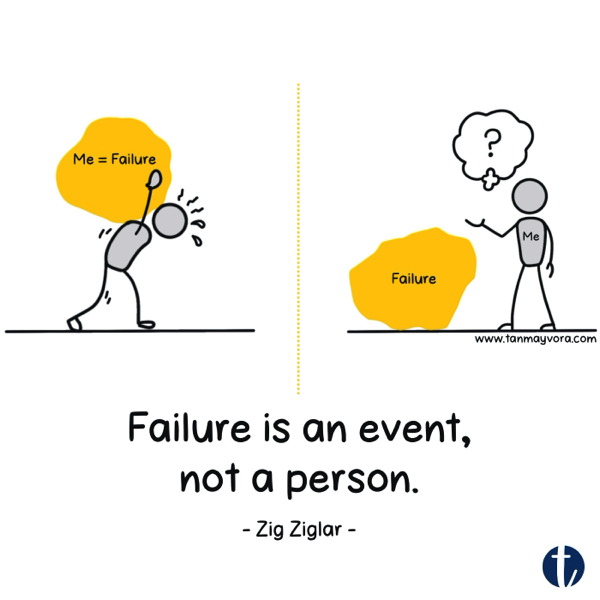
There’s a lesson for leaders here as well. When someone around us fails, how do we close the learning loop. Here are a few things that come to mind:
- Shift from “Who” to “What”: Instead of asking “Who messed this up? (person)”, the better question to ask is, “What happened? (event)”
- Do active inquiry: Investigate an outcome with a curious stance. Ask questions that bring out the root causes, help others think through, and learn from the failures.
- Create safe environment: People will only put their failure boulder down if they know that they will not be judged for sharing their failures with you. Amy Edmondson calls this “Psychological Safety”. This is the bedrock of a learning culture.
Leadership Reflection:
As a Visual Leadership Facilitator, I often see leaders (and even parents) struggling with this transition. We want innovation but we are also terrified of being labeled as a “failure”.
The next time something doesn’t go as planned, take a deep breath and bring this visual nudge to the forefront.
Visualize:
- Are you carrying the event as a burden on your back?
- OR are you standing back, seeing it objectively, and learning from it.
Learning only begins when we stop being the failure and start being the student of it.
Visual Nudge: Hand-Drawn Mental Models for Life and Work
In a noisy world, we don’t need more information. We need better anchors to think.
Visual Nudges is a collection of bite-sized and minimal visual ideas created for quick grasp, easy recall and instant resonance.
I have curated and hand-drawn high-impact Visual Nudges that will gently do what they are intended to do – nudge you to think, reflect, and act.