Leading in the Age of Co-Intelligence: Redefining Leadership and Decision Making
Insights from a recent panel discussion to explore how leadership and decision making have to evolve in the age of co-intelligence.

Tanmay Vora
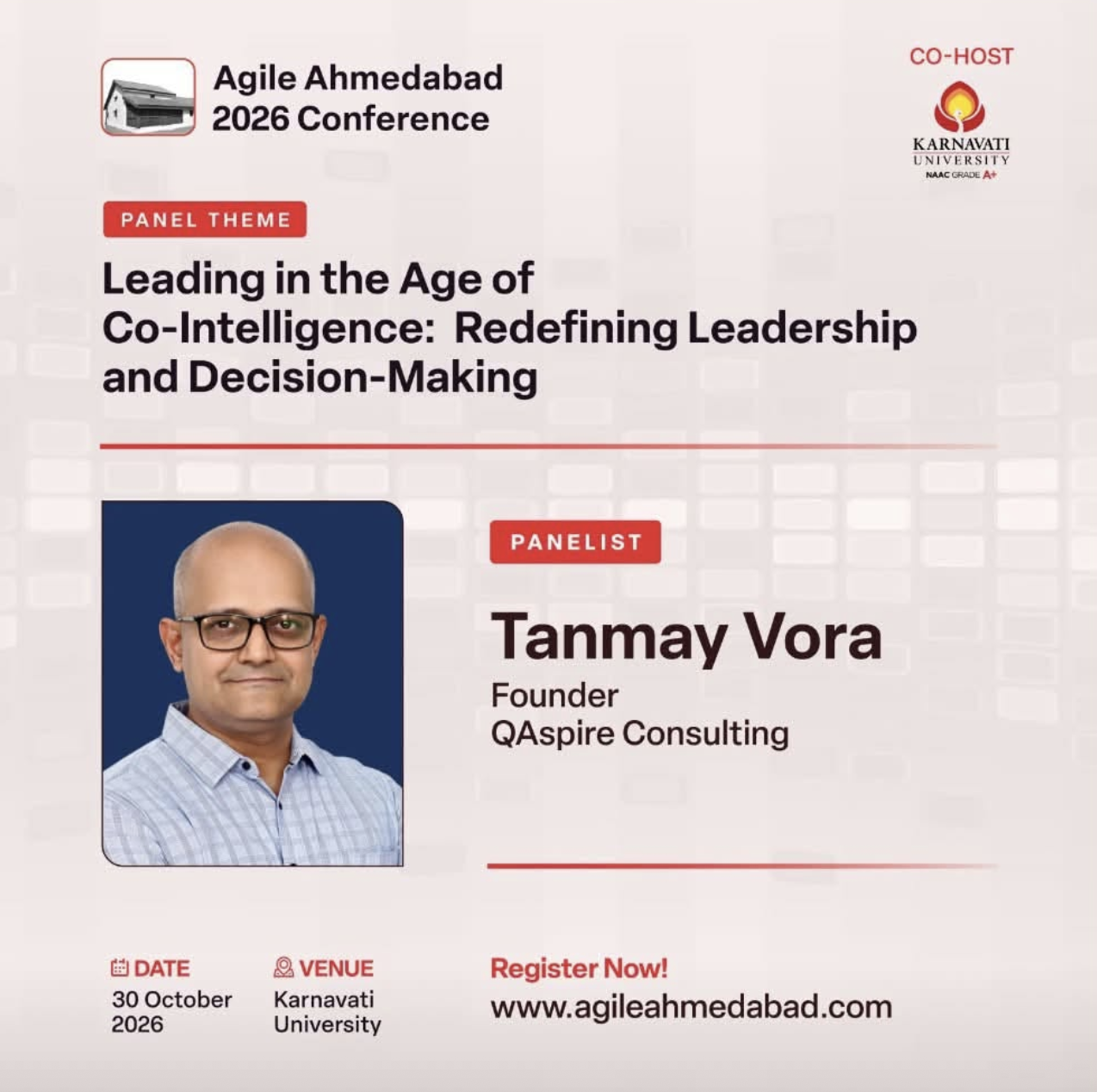
I was recently invited at Agile AhmedabadConference 2026 to be on a panel to explore how leadership and decision-making are being redefined in the age of co-intelligence.
AI drives performance, works with people, synthesizes information from diverse sources, co-ordinate steps, understand the context, and executed work within defined boundaries. As humans start working closely with AI agents, the era of co-intelligence is upon us.
Here are a few questions we discussed in the panel, with my thoughts on each of those questions:
1. As organizations move from artificial intelligence to co-intelligence, how should leaders redefine their role in decision-making, problem solving, and value creation?
- Leaders stop being experts and start being facilitators of work and ideas that flow between humans and AI. They frame the right questions, bring people together to facilitate conversations, and own the context of decisions. Leaders become designer of a conversational space.
- Leaders no longer use AI to simply automate tasks but to widen the options, challenge assumptions while owning judgment, trade-offs, and consequences. Also invite AI to challenge you, not just agree with you.
- Leaders in business context ultimately own the value being delivered to customers – where value is defined by human insight combined with machine scale – not just automation of old ways of working.
- AI scales intelligence, but through facilitation, leaders scale wisdom because in age of cointelligence, value moves from efficiency to a sound judgment.
2. What are the biggest barriers preventing enterprises from moving beyond AI pilots and embedding intelligent collaboration into their core business operations?
- Pilots are experiments that are primarily led by technology. While they answer how a new techology can solve a business challenge, they are largely disconnected from complexity of real workflows, P&L ownership, and business outcomes.
- AI feeds on data and therefore lack of proper data in legacy systems and accountability thereof can be a barrier to scaling.
- Every change brings along fear – and working through that fear requires adequate change management . Organizations have to invest in change management practices to build trust with people to use AI seamlessly.
3. How will co-intelligence change the way organizations design jobs, structure teams, and define the relationship between human expertise and digital agents?
- Jobs are increasingly being redesigned such that humans own the context, judgment, empathy, and creative thinking while AI agents handle routine boundaried work.
- With this, the teams are becomign smaller, cross-functional and truly hybrid. Agents are now team members with defined roles.
- This means expertise isn’t only about knowing answers but asking better questions, think differently, challenge assumptions, uncover biases, and think critically around AI outputs.
4. How can leaders preserve trust, quality, and accountability when critical business decisions are influenced by AI-generated insights?
- I have seen organizations who keep a named human for every AI influenced decision making. AI advises but never owns. One organization I work with have created RACI matrix for hybrid teams where Responsibility of execution can be with AI, but accountability of outcomes is always with a human role.
- Trust is built when we make AI cite sources, assumptions, confidence levels, unforeseen risks, and by reviewing outputs as a process.
- Put AI governance mechanisms in place to ensure that risks and vulnerabilities related to AI are detected and mitigated early in the cycle.
- Treat AI like a confident new-hire who is fast, valuable, occasionally wrong and never allowed to sign-off something.
5. What decisions should always remain human-led, and where should leaders be comfortable allowing AI or intelligent systems to take the lead?
- It is always advisable to keep those decisions with humans where ethics, values, people’s lives, livelihoods, and strategic direction are involved. Decisions where cost of reversability is high should always involve a group of humans to decide.
- If AI starts answering questions for you, like “What should be our strategic focus?” or “What do we really want to stand for as a company?”, it pushes us towards mediocrity. We can ask those questions to ignite our thinking, but we have to build upon it through our lived experience and wisdom.
- Leverage AI extensively for boundaried work that is high-volume, data-heavy, processing intensive, or repeatable decisions with clear rules (e.g. reviewing code against a defined checklist). We can let AI take decisions that have low cost of reversability.
- For everything in between, use “humans in the loop”, revisit context, goals, boundaries regularly as trust, and AI capability evolve. This is the messy middle where AI can be 95% right, and humans become complascent. This is why AI governance is vital to ensure sufficient checks and balances.
6. How can enterprises create a governance model that balances innovation with data privacy, regulatory compliance, security, and ethical responsibility?
- Institutionalize governance of AI initiatives through frameworks like ISO 42001 or CMMI-AI. This creates a structure of cross-functional governance involving technology, legal, HR, finance and business.
- Adopt a risk-first approach. Start defining governance with identifying risks first. Establish controls for high-risk and high-impact usage of AI while lowering the guardrails for low-risk, low-impact usage.
- Governance can prove to be an enabler of speed with right approval mechanisms, processes, structures, and checks at each stage of the process.
7. What new leadership behaviors and skills will distinguish organizations that successfully collaborate with intelligent systems from those that simply deploy more technology?
- Leaders have to be “hands-on” – they cannot delegate the use of AI if they don’t understand the nuances of delivering value using AI. Being curious and experimenting is an invaluable skill for leaders in the age of AI.
- Leaders deliver unique value to customers through AI when they think creatively and critically. This means thinking beyond AI generated responses, connecting the dots to form a big picture, challenging assumptions and biases, and asking right questions. Leaders also need humility to remain open to being challenged by AI.
- Building psychological safety within teams is invaluable when we expect our team members to work with agents, experiment and find new ways to deliver value. Failure is an integral part of all these, so building an environment where people feel free to challenge each other, ask questions without fear, and experiement without fear of failure is absolutely critical for success in this world.
_8. How should enterprises measure the success of co-intelligence initiatives beyond cost reduction—for example, through better decisions, faster innovation, improved customer outcomes, or employee experience?
- Track customer impact and value delivered through voice of customer programs, measurable outcomes for customers, NPS and so on. An organization only succeeds when customers succeed.
- Track decision quality for speed, confidence, cost of reversal, and ultimately outcomes that those decisions generate for the organization and for the customer.
- Track employee experience in terms of engagement with the organization, alignment with priorities, AI adoption, trust, and growth in skills and competence.
- Learning velocity: How quickly do experiments become shared practices across the organization?
9. If you were advising a CEO beginning the co-intelligence journey today, what is the one strategic action you would recommend in the next 90 days?
- Pick one high-value business decision or workflow. Rethink it for efficiency and outcome. Redesign it end-to-end as a human-AI collaboration.
- Define accountabilities – define who owns, who decides what, with clear human checkpoints in place.
- Learn visibly, share your lessons, bring people together to share theirs, and build a playbook for scaling across organizations.
- Think about AI governance practices at the onset of the journey, not as an afterthought.
Over to you: What do you think about the conversation points? What would you add, or challenge in the list above? I am curious to know.