Psychological Safety Playbook for Changemakers: Turning Beliefs Into Behaviours That Build Trust
A brand new playbook on Psychological Safety for Changemakers

Tanmay Vora
If you are a changemaker – and you are – knowing how to foster psychological safety is not optional. In fact, it is the work.
I’ve observed that even when leaders understand why it matters, they look for specific guidance for turning their belief into lived behaviour and sustained action. That gap between knowing and doing is where culture takes a hit.
Why Building Psychological Safety is Important for Change Professionals
This gap becomes even more critical when leading change, where your only real currency is cross-functional trust, influence and connection that is built deliberately over time. Because people only change when they feel safe to act differently, speak up, fail and learn with others.
Karolin Helbig and Minette Norman’s new book – The Psychological Safety Playbook for Changemakers – addresses this gap for changemakers. I had the wonderful privilege of creating a hand-drawn visual summary of the book, just as I did for their earlier book “The Psychological Safety Playbook”.
As someone who has built high-performing teams, and now facilitates Psychological Safety Playbook workshops, I have seen firsthand how transformative these ideas can be when leaders actually live them. Here is the sketchnote summary of the book, which was shipped along with the book for early orders as a beautiful postcard print.
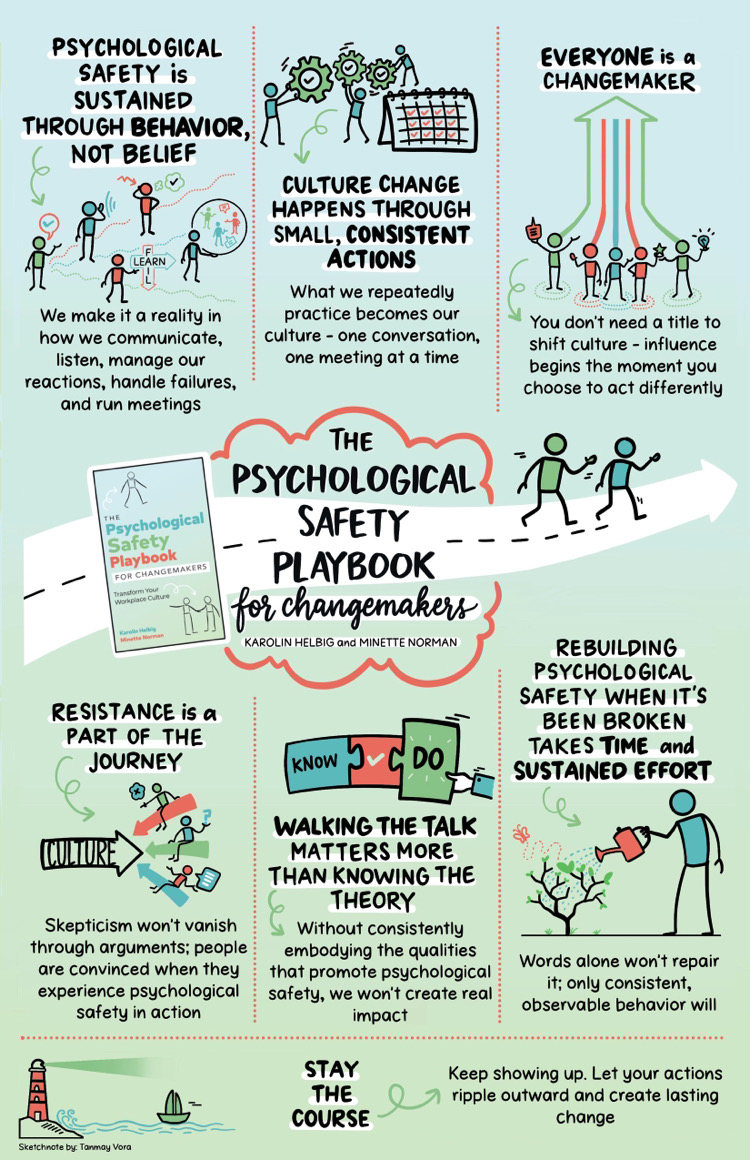
The book’s central premise is: Everyone is a changemaker and influence begins the moment we choose to act differently and walk the talk.
The key is to stay the course and your actions ripple outward.
The Podcast Conversation
Here are a few gems from the conversation:
Psychological safety is the foundation of trust, learning, innovation, and meaningful change. It’s not built through intention alone – people can only feel it through consistent behavior.
– – – – –
Integrity from ancient Indian wisdom: Integrity is alignment between Mann (mind) + Vachan (words) + Karma (actions). All three must fall in a straight line for a leader to be integral.
– – – – –
Influence begins the moment you choose to act differently.
– – – – –
Change resistance is an opportunity to be more curious and listen. Resistors become a part of solution when they feel heard and seen.
– – – – –
Cross-functional influence (without authority) requires a great deal of relationship building and acknowledging that we are smarter collectively than individually.
– – – – –
Everyday behaviors must be congruent with what you say you care about.
– – – – –
Cultivate genuine curiosity — shift the mindset first, and the right words will follow naturally
– – – – –
Redesign how you run meetings to include every voice and tap the full brain power of your team
BONUS:
- Read all posts related to Psychological Safety on this blog
- As a Certified Facilitator, I conduct structured organizational workshop on The Psychological Safety Playbook. Reach out if you are looking for equipping your leaders with a playbook on creating safe environment for your teams.