The Decide-Do Gap: Why the Distance Between Intention and Action Defines Your Results
Shortening the gap between deciding and doing is a great way to beat resistance.

Tanmay Vora
Most people fail because of their inability to close the gap between what they decide and what they actually do. Intentions rarely make us great, actions do. It took me a while to understand this, and yet, I still fall in the trap of forming grand plans in my mind without thinking through the execution.
Derek Sivers puts it succintly: “Extraordinary lives are built not by talent or circumstances, but by collapsing the space between intention and reality. The smaller that gap, the more your inner force translates into outer motion.”
Let’s unpack this using the S.T.A.R. framework for Visual Nudges:
Sketch
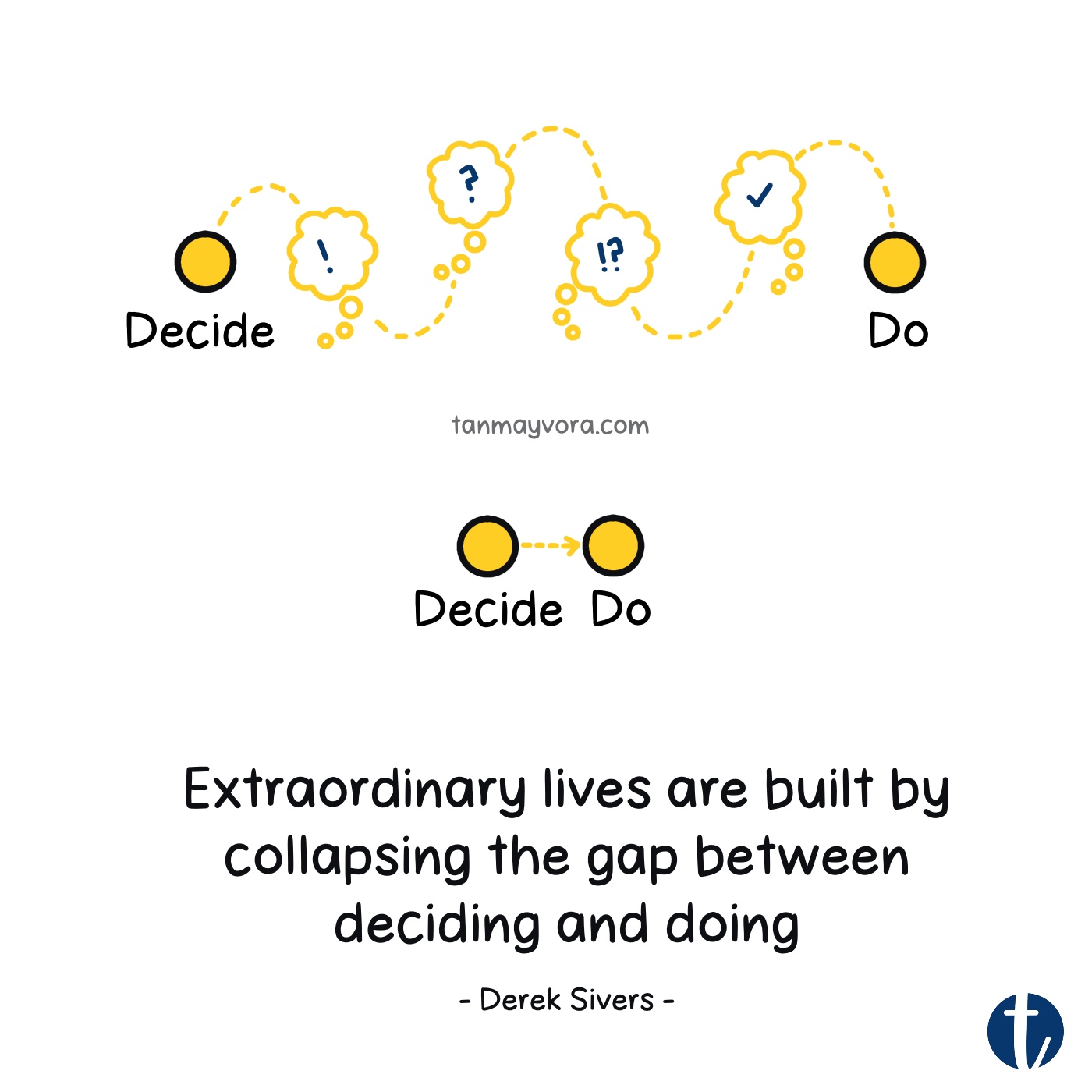
Two journeys with same starting point of deciding, and destination of doing. The first path is a long and winding loop full of second-guesses, hesitation, and noise that clouds the space between intention and action. It is a form of resistance.
The second path is a short, direct arrow. In this small space, something gets done, however small. It is forward motion, and the best way to beat resistance.
Takeaway
- Shortening the gap between deciding and doing is a great way to beat resistance. This does not mean reckless action, but quick action once you have thought through and decided.
- When you collapse the gap and move from “I should do this” to actually doing it, you multiply your ability to get more done. You operate in a mode where your inner life and outer life are in a constant and tight conversation.
Action
- When you notice yourself in the winding loop of doubt and delay, ask: “What is the smallest action I can take right now to move this forward?”
- Build a personal rule: every decision gets a next action assigned to it immediately.
Reflection
- As yourself this question, “Where in my life am I stuck in the long loop – and what is the real cost of that gap to me?”
Bonus
Explore Visual Nudges: Hand-Drawn Mental Models for Life and Work – 109 provocations to help you think clearly and act better.