Visual Storytelling for Leaders: How to Turn Complexity into Clarity and Inspire Action
Leaders who combine storytelling with visual communication help people see the bigger picture, connect with change, and act with clarity. Here's how visual storytelling works - and how to practice it.

Tanmay Vora
In Mumbai yesterday, I facilitated an experiential session on Visual Storytelling for Leaders at the People Matters BFSI Talent and Tech Conference. The room was full of CHROs and senior HR leaders — people who work with complexity for a living.
Most participants acknowledged that change communication in a multigenerational workplace is challenging. That leaders see the full picture but can only communicate a part of their intent. That leads to misalignment in execution.
And isn’t that the real problem in most large organizations: Not a lack of data or strategy, but a breakdown in communication?
The Real Leadership Communication Problem
In organizations today, information is everywhere, but meaning is scarce. Leaders carry the weight of their context – see strategy, risks, direction – but struggle to translate that into something people can feel, understand, and act on.
Leaders need to show data, but then also show the meaning behind it all. If people don’t understand why something matters to them, they will not effectively engage with your ideas.
This is where most communication from leadership breaks down. We present data, share decks, share updates and the question people end up asking is: Where’s the story? What does this all mean? What’s in it for me?
The real question that leaders need to ask is not, “How do we share more?”, but “How do we help people see what it all means?”
I found some potential answers in two disciplines: Storytelling and Visual Communication.
Why Storytelling Works
Storytelling is not a soft skill but a cognitive tool. It matters for leaders because:
- Stories make information memorable. Facts are processed analytically. Stories are processed experientially.
- Stories create emotional connection. Our brain engages with characters, struggles, and outcomes at an emotional level. When you connect a strategic shift to a real challenge your team is facing, or to a customer whose life is being changed, you give people a reason to care.
- Stories build context for data. Data drives decisions, yes — but storytelling helps people see what the data means in a larger picture.
Why Visual Communication Works
Communication in organizations is text-heavy – long mails, busy newsletters, dense slides and reports that take 20 minutes to read. This is cognitive load for readers who are already stretched and overwhelmed with exploding information.
Visuals work differently because:
- We process visuals faster than text. A well-structured diagram, a simple visual metaphor that makes story visible, a mapped journeyon a page can reduce cognitive load in a way that paragraphs can’t.
- Visuals create shared understanding. Drawing something means everyone sees the same picture. It aligns faster and reduces interpretation gaps.
- Visuals make abstract ideas concrete. Strategy, culture, purpose.. these are all abstract. But turn them into a picture and they become tangible.
What Happens When You Combine Them
Storytelling provides a structure along emotional resonance. Visual communication gives you clarity and speed of processing. They become more powerful when you are able to put them together.
Visual storytelling is:
- Stories that you can see (and ideas in visual stories stick)
- Stories people can relate with because they are human and specific
- Ideas that resonate both emotionally as well as intellectually
- Stories that enable cognition through use of metaphors and human figures
- A clearer view of bigger picture without losing the essence or details that matter.
This matters enormously in an ever changing business context. You’re asking people to navigate change, cultural transformation, digital adoption.. all simultaneously. If a leader is not able to tell a coherent, human, visible story about where the organization is going, and why, people will use their own interpretation. That misalignment is costly for organizations.
How to Do It: Two Simple Building Blocks
Visual storytelling may sound sophisticated but it starts with two very practical tools.
1. A Story Structure
A good story structure prevents rambling and creates flow. Let’s take an example of Pixar’s Story Spine which goes like this:
- Once upon a time… (context)
- Every day… (the pattern / the status quo)
- Until one day… (the disruption)
- Because of that… (consequences)
- Until finally… (the resolution)
- And ever since then… (the new normal)
Run any change narrative through this structure – a digital transformation, a merger, a culture reset – and it immediately becomes more coherent and human. It has a default state, a tension building up, progression (rising action), and ultimately resolution. It tells people: this is where we come from, here’s where we are, that’s what we are facing, here’s what will change, and this is how our transformed state will look.
Combine the story spine with a visual metaphor – say, a journey metaphor drawn on a page, and you have a visual story. A picture people can see, discuss, and remember.
1. A Visual Metaphor
A metaphor makes an abstract idea relatable.. we used journey metaphor to plot the story we created using the story spine: you’re here, you want to reach there, here’s the terrain, here are the obstacles, here’s where we are going, and here’s why.
This works for strategy, for change, and for performance related conversations. What metaphor you choose matters than the act of choosing one because it forces clarity.
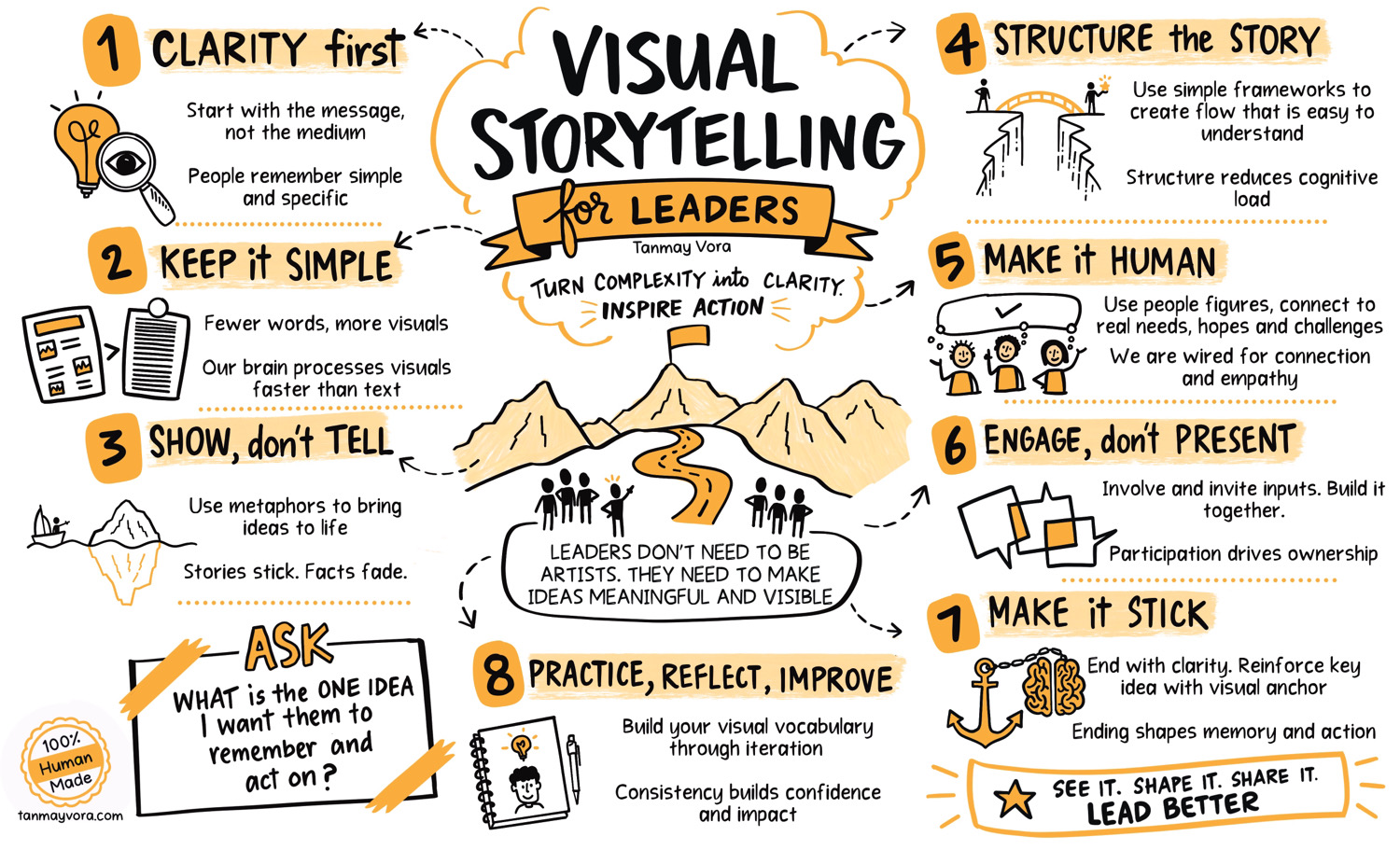
8 Tips for Visual Storytelling (Sketchnote)
I created a sketchnote summarising eight practical principles for leaders who want to practice visual storytelling.
Leaders Don’t Need to Be Artists
In my workshop, people often come with a reservation saying: “I can’t draw.”
The thing is: you don’t need to draw well. You need to make ideas visible and meaningful. A stick figure, a simple box with an arrow, a rough mountain with a path are enough. It will still create more clarity than a polished slide will.
Start here: What’s one idea that I want people to remember and act upon?
Then find the simplest way to make it visible.
Bottomline
Visual storytelling is a leadership practice, not just a presentation technique. It is about helping people see what you see, feel what matter, and clearly know what to do next.
Start small. Draw something in your next team meeting. Tell the story of your strategy as a journey. Use a metaphor to explain a complex change. See what happens to the conversation.
The tools are simple, but powerful enough for impact to compound.
If you lead strategy or change in your organisation and want your teams to truly see the bigger picture, let’s connect. I work with leadership teams to build clarity and alignment through visual storytelling.